
A New Stroke and Brain Injury Breakthrough
© 2014 – 2024 60 Minutes Australia and INR PLLC, all rights reserved
REQUEST A CONSULTATION TODAY – CLICK HERE
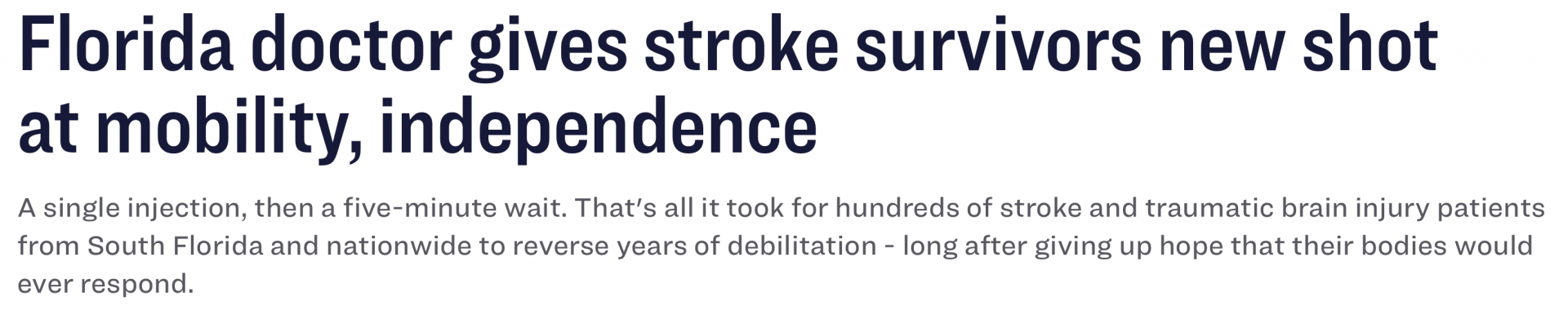
Click here to read the complete news story
DRUGS.COM REVIEW: PSE FOR POST-STROKE RECOVERY
LINKS TO SOME OF THE HUNDREDS OF VIDEOS DOCUMENTING RAPID IMPROVEMENT IN STROKE PAIN, WALKING, SPASTICITY, SWALLOWING, FATIGUE, COGNITION, APHASIA, etc. FOLLOWING THE BREAKTHROUGH PSE STROKE TREATMENT INVENTED BY EDWARD TOBINICK, M.D., as described in the peer-reviewed medical literature:
- 2022: Dramatic relief of chronic central stroke pain after PSE – 2022
- 2022: Multiple neurological improvements following PSE – 2022
- 2021: Dramatic improvement in chronic post-stroke fatigue after PSE – 2021
- 2021: PSE reduces pain & improves walking 3 years after stroke – 2021
- 2020: Able to walk without a cane following PSE treatment by Dr. Tobinick – 2020
- 2020: From wheelchair to walking unassisted after PSE, 2 years after stroke – 2020
- 2020: Rapid improvement in cardiac arrest brain dysfunction after PSE
- 2019: Immediate improvement in stroke-induced visual loss & chronic stroke pain
- 2018: Many improvements after PSE treatment for a chronic brainstem stroke
- 2017: “My leg feels light as a feather,” walking improved after PSE treatment
- 2016: Andrew Marr of the BBC before and after treatment by Dr. Tobinick
- 2015: Rapid improvement in vision impairment due to stroke after PSE
- 2015: Improvement in stroke pain, spasticity and mobility after PSE
- 2014: 60 Minutes Australia “Reverse Stroke” with captions – One Million+ views
- 2012: Rapid neurological improvement following PSE 45 years after TBI
- 2011: Rapid neurological improvements following PSE, 17 years after stroke
- 2011: Physician discusses rapid improvement after PSE, 10 yrs. after stroke
- 2011: Sustained improvement following PSE treatment, 5 yrs. after stroke
- 2010: A New Stroke Breakthrough by Edward Tobinick MD
Individual results vary, please see the Terms of Use and the INR scientific publications.
More information:
- The Institute of Neurological Recovery Facebook Page
- NEWS REPORTS ABOUT DR. TOBINICK’S BREAKTHROUGH STROKE TREATMENT
- The Institute’s stroke videos on YouTube
- Edward Tobinick M.D. on LinkedIn
- Dr. Tobinick on Doximity
- Dr. Tobinick’s scientific publications, including links to find and download these articles
- Dr. Tobinick’s scientific citations on Google Scholar
- 2018: Australian Government designates funds to study INR’s PSE stroke treatment
- 2020: University Clinical Trial Confirms the Efficacy of PSE
Request A Consultation
Receive detailed information regarding the Institute’s unique, patented, anti-inflammatory treatment. We currently treat and accept new patients from around the world, even years or decades after stroke or traumatic brain injury.
Contact Us
Florida
Institute of Neurological Recovery
1877 S. Federal Hwy., Suite 110
Boca Raton, FL 33432
Phone: +1 (561) 353-9707
Fax: +1 (561) 372-7874
Email: INRBoca@gmail.com
Follow us on our social media pages: